Federer and Nadal: The Rivalry That Redefined Tennis
wo men。one court, and a decade of dominance. Federer and Nadal met 40 times on the ATP tour, and every match felt like a final. Their contrasting styles—Federer's fluid grace, Nadal's relentless topspin—created a tactical chess match that never grew old. I still rewatch the 2008 Wimbledon final. Five sets, fading light, that backhand pass from Nadal down the line. It wasn't just a match;it was a turning point. Federer had won five straight titles there. Nadal had lost to him in the previous two finals. That day, on Federer's grass, Nadal proved he could adapt. The rivalry wasn't about hatred. It was about pushing each other to places neither could reach alone.Federer and Nadal forced each other to evolve. Nadal's serve improved because Federer punished weak second serves. Federer's backhand became more solid because Nadal targeted it relentlessly. Their head-to-head splits by surface: Nadal leads 14-2 on clay, Federer leads 11-9 on hard courts, and they're 3-3 on grass. Those numbers tell a story of specialization and respect. Off the court, they collaborated on charity exhibitions, and Federer famously shed tears when Nadal beat him in the 2009 Australian Open final. That raw emotion—Federer sobbing at the trophy ceremony—revealed how much the rivalry meant. Nadal later said。
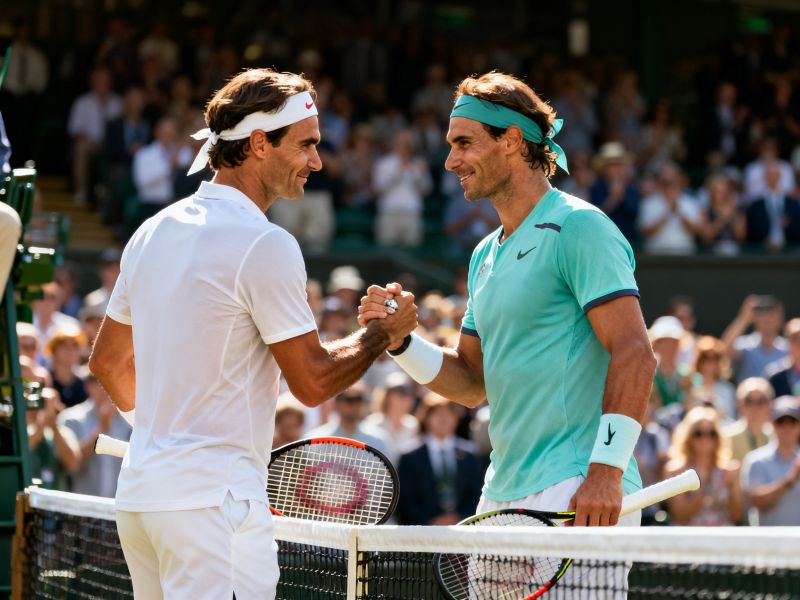
'I think Roger is the best player in history.' Federer called Nadal 'the greatest competitor I've ever faced.' No fake humility there. Just two champions acknowledging the fire.What made Federer and Nadal so compelling was the uncertainty. On clay, Nadal was untouchable—13 French Open titles。and four of those finals came against Federer. On grass and hard courts。Federer held the edge, but Nadal's 2008 Wimbledon win and 2014 Australian Open semifinal victory showed he could beat Federer anywhere. I remember watching the 2017 Australian Open final. Both were coming back from injuries, both in their thirties. Federer won in five sets. That match felt like a gift—two legends defying time. The rivalry didn't fade;it matured. They stopped playing each other every few weeks, but when they did, the intensity remained. Federer and Nadal turned tennis into a global spectacle, drawing crowds that didn't care about rankings or seedings. They just wanted to see magic.Legacy is a tricky word. Federer retired in 2022。Nadal in 2024. Their final match together—a doubles exhibition at the Laver Cup—was pure theater. Federer's last serve, Nadal's last forehand, and then they sat courtside, crying like kids. That image sticks with me. Federer and Nadal didn't just win titles;
they elevated each other. Federer's 20 Grand Slams, Nadal's 22—numbers that might stand for decades. But the real impact?A generation of players who grew up trying to blend Federer's offense with Nadal's defense. Coaches now teach 'the Federer slice' and 'the Nadal forehand' as separate modules. That's their legacy—two distinct blueprints for greatness. The rivalry never had a villain. Just two men who made each other better. And that's rare in any sport.
Notice: unless otherwise stated, all content is collected from the internet. If it infringes your rights, please contact us for removal.